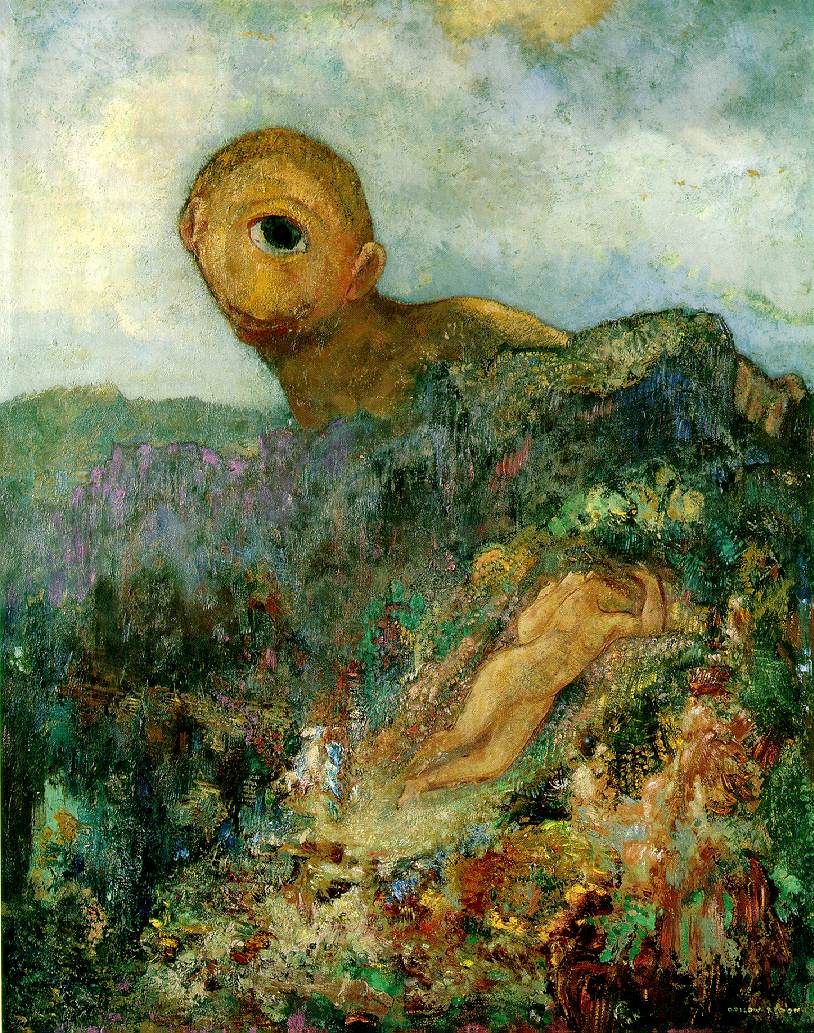
After my last post I started to think more about the public perception of the mythical creatures known as Cyclops. being interested in ancient history and mythology I realised that the common view of these creatures as dim witted monsters is almost entirely based on Homer's Polyphemus. in true Greek mythology the Cyclops was seen in a very different light that has roots in bronze age history. It is believed that during the late bronze age and the Mycenaean empire the highly skilled black smiths would be distinguished from common men by painting a small circular shape on to there forehead. After the fall of the Mycenaeans and the start of the Greek dark age working bronze became a forgotten art after the prevalence of iron. stories traveled of these ancient marked men that could work metal like no modern man and so the myth was born. In the work of Hesiod the Cyclops are the ones that create the armer and weaponry of the Olympians during there war with the Titans. This view of Cyclops being intelligent creators and artisans has been lost somewhat in popular culture and I think it would be very interesting to explore in my work, rather than completely recreating the idea of the Cyclops like Redom maybe it would be useful to reintroduce people to there original depiction as seen through my eyes.
Monday, 10 February 2014
After my last post I started to think more about the public perception of the mythical creatures known as Cyclops. being interested in ancient history and mythology I realised that the common view of these creatures as dim witted monsters is almost entirely based on Homer's Polyphemus. in true Greek mythology the Cyclops was seen in a very different light that has roots in bronze age history. It is believed that during the late bronze age and the Mycenaean empire the highly skilled black smiths would be distinguished from common men by painting a small circular shape on to there forehead. After the fall of the Mycenaeans and the start of the Greek dark age working bronze became a forgotten art after the prevalence of iron. stories traveled of these ancient marked men that could work metal like no modern man and so the myth was born. In the work of Hesiod the Cyclops are the ones that create the armer and weaponry of the Olympians during there war with the Titans. This view of Cyclops being intelligent creators and artisans has been lost somewhat in popular culture and I think it would be very interesting to explore in my work, rather than completely recreating the idea of the Cyclops like Redom maybe it would be useful to reintroduce people to there original depiction as seen through my eyes.
Sunday, 9 February 2014
In Odilon Redon's painting "Cyclops" a man (most likely Homer's Odysseus) is hiding to escape the wondering cyclops (probably representing Polyphemus). While the technical aspects of the painting such as the murky colour pallet mixed with vibrant splashes of red, yellow and green interest me what really grabs my attention is the way that Polyphemus has been painted. Homer portrays the Cyclops as being a harsh, barbaric creatures that feast on the flesh of men, they were obviously meant to scare his audience. This barbaric humanoid figure has been depicted in many paintings and drawings over the years in much the same way which makes Redon's reinterpretation of the character very interesting. Instead of a humanoid figure Redon has painted a sickly yellow figure with a circular noseless head that stares at the viewer. Instead of an appearance of anger or malice the cyclops seams serene and calm which makes the blood covered smiling mouth much more disturbing. This reinterpretation of a well known creature creates a shocking painting that can freely display the views and styles of the painter much more freely than a painting that is restricted by traditional ideas. Using a well known story such as this and using it to express my own unique interpretation would be a very interesting concept to try in my work.
Subscribe to:
Posts (Atom)